What is a company brain? Explanation, examples and what it isn't
By Mike van BeaumondAI Engineer · company brain & automationpublished on
10 min read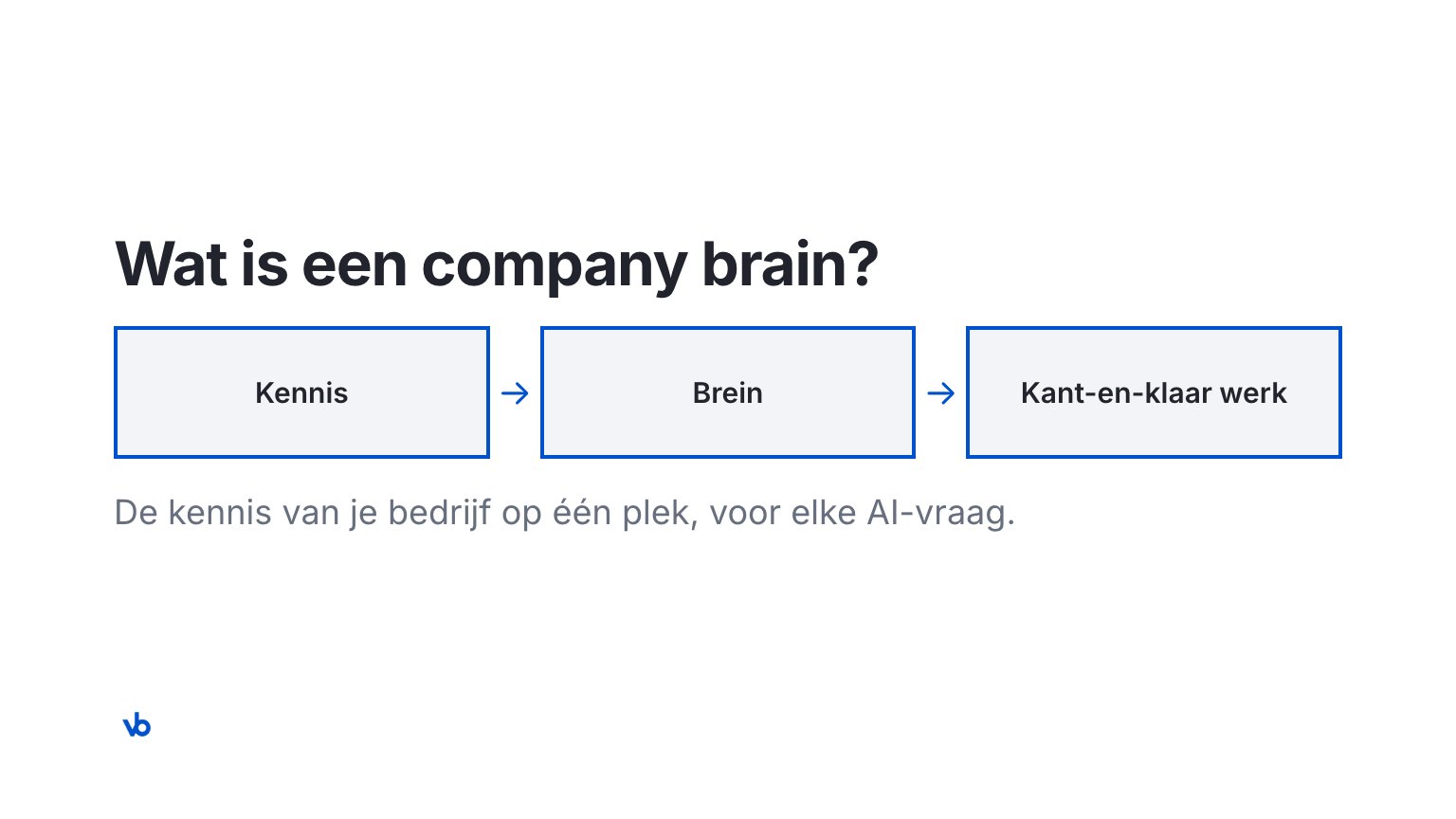
A company brain is your company's knowledge, captured in one place. Think of your offer, your customers, your tone of voice and your rules. Your AI tool uses that knowledge for every question. That way everyone on your team gets work that matches how you work. And you decide what happens with it.
Quick Take: A company brain is not a new app and not a smart chatbot. It is your company's knowledge, captured per topic, with an owner who decides what is correct. Your AI tool then works as if it has been with you for years. The brain delivers the work, you decide.
I explain it using the brain my own company runs on. You will read what is in it, how you use it and what it means for your role. And also what it deliberately is not, because that is where many explanations go wrong.
Why does a company brain matter now?
Short answer: AI increasingly shapes what people read about your company and what your team produces. So the knowledge AI draws from has to be right.
Your buyer already lets AI build a shortlist. They ask ChatGPT or Claude which suppliers fit. They read a summary of your company before they see your website. Then they check with a person whether it is true.
AI often knows who is asking. The role is in the question, or the AI knows it from memory. A finance director then gets a different answer than a sales director. What AI finds about you has to be right for every role. And your team has to work from the same knowledge, so the conversation afterwards is right too.
I am not the only one who sees this. Y Combinator, the well-known startup program in the US, asked this year for companies that build a company brain (source: Y Combinator, Requests for Startups Summer 2026, April 2026).
I expect AI agents, AI that carries out a series of tasks by itself, to do more and more for companies. Such an agent only works well if it knows how your company works. In my words: "It is already partly happening, it is becoming more important, and now is the time to get it right."
What is in a company brain?
Short answer: everything a new colleague needs to know to do good work. Not in loose documents, but per topic, with clear agreements.
A good brain has five building blocks:
- Knowledge per topic. Who you are, what you offer, to whom, how you sound and what you promise.
- An owner per topic. One person decides what is correct and keeps it up to date.
- A label. Can this text go out word for word, or is it an internal rule?
- A never list. What never goes into the brain is agreed in advance.
- Skills. Fixed ways of working that turn that knowledge into ready-to-use work.
This is what one topic from my own brain looks like:
| Topic | What never goes into the brain |
|---|---|
| What it says | No names or details of people, no customer data, no payment details, no passwords, no HR files and no contract amounts |
| Owner | Management (in my case: me) |
| Can it go out? | No, this is an internal rule |
| Last updated | 1 November 2026 |
So customer data is not in it. A skill fetches it from your CRM at the moment it is needed. The brain knows how you work; your systems know what is happening right now.
How do you use a company brain?
Short answer: you ask a question in your own AI tool and get ready-to-use work back, made with the knowledge from the brain.
I work in Claude myself. The brain works through MCP, an open standard that lets an AI tool access your knowledge securely. That is why it also works in other AI tools that support MCP.
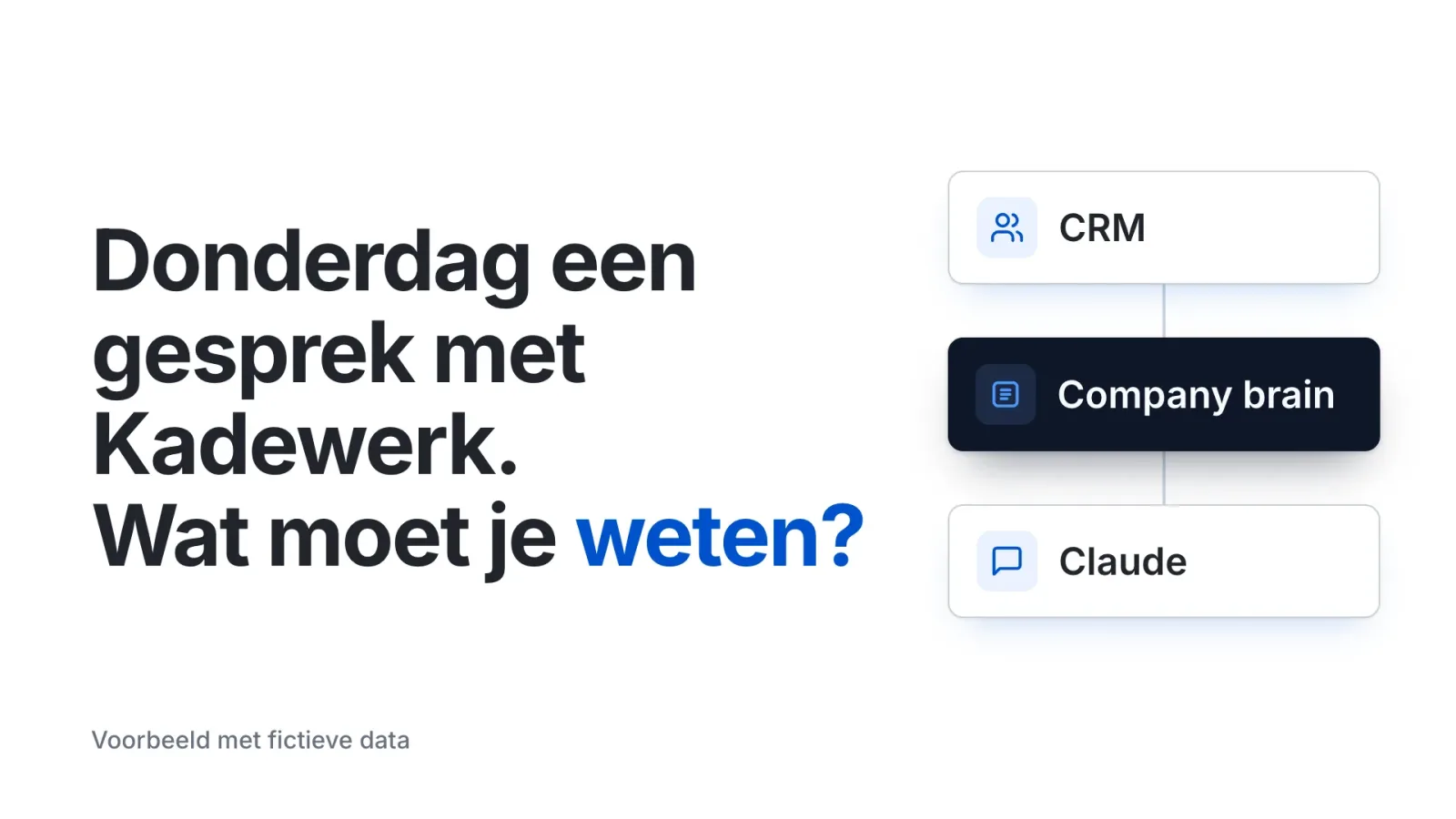
The work happens through skills. A skill is a fixed task that turns the knowledge from the brain into work, such as preparing a meeting. This is what that looks like:
- You ask: "Prepare my meeting tomorrow."
- The skill fetches the customer from your CRM.
- The brain adds what fits: which offer, which questions to ask, which objections to expect.
- You get a one-page briefing.
- You read it, adjust it and decide what you use.
Work that takes hours now is ready in minutes. What that saves your company, you work out with your own tasks, not with a general percentage.
What does a company brain mean for your role?
Short answer: everyone uses the same knowledge, but for different work. What it delivers depends on your role.
- Management: your team spends less time searching and explaining, and more on what matters.
- Operations: people decide, and what never goes in is agreed in advance. That makes AI something you can trust.
- Marketing: everything that goes out tells the same story, in your tone. Also read AI content doesn't sound like you.
- Sales: you go into every meeting prepared, with the offer that fits. See the company brain.
- Customer success: customer questions get an answer with a source, and what sales promised is in the onboarding plan.
- RevOps: the same ideal customer, the same personas and the same offer everywhere, including in your systems.
- HR: an onboarding plan per role, and recurring policy questions get an answer with a source.
A project starts with the department you choose. Then the brain grows with you.
Is a company brain not just ChatGPT on your documents?
Short answer: no. ChatGPT on your documents finds text. A brain also knows which text is correct, what can go out and who maintains it.
Many tools put AI on top of your folders. That is called RAG: the AI first searches your documents and then writes an answer. That works, but the AI also finds the old version. And nobody says which text applies.
A second brain looks similar too. That is one person's personal note system. Useful for yourself, but your colleagues and your AI tool cannot build on it.
| What it does | Knows what is correct? | Knows what can go out? | Produces work? | |
|---|---|---|---|---|
| Knowledge base or wiki | Stores documents | No, every version is in there | No | No |
| Second brain | Notes of one person | Only for that person | No | No |
| ChatGPT on your documents | Searches and summarises | No, also finds old versions | No | Sometimes, without your rules |
| Company brain | Knowledge per topic with owner and label | Yes, the owner keeps it current | Yes, through the label | Yes, through skills |
You do not have to throw out your current tools. The brain is added as the layer that says how you work. Read more about the difference in Knowledge base or company brain?
What is a company brain not?
- Not a chatbot. A chatbot gives answers. The brain produces ready-to-use work, such as a briefing, a blog or an onboarding plan.
- Not a dashboard. Live figures stay in your CRM and other systems.
- Not a search engine. It also knows your rules, your tone and what must never go out.
- Not a replacement for your team. Your team learns to work with it and keeps deciding.
Who maintains the brain, and what if it gets something wrong?
Short answer: every topic has an owner. If something is wrong, you report it, and the owner fixes it.
This is how it works for me:
- Someone sees that something is wrong or missing, and reports it from the AI tool.
- The report goes to the owner of that topic.
- The owner approves or rejects the change.
- The new version applies immediately to everyone and to every skill.
So the AI cannot change the brain by itself. And if knowledge is missing, a good skill says so instead of making something up. Every topic also gets a date on which the owner checks it again.
Is my company knowledge safe in a company brain?
Short answer: you decide in advance what goes in, who sees what and what goes out. Sensitive data does not go in.
- Never list: personal data, customer data and secrets do not go in.
- Access per department: a colleague sees the knowledge of their own department, plus what is shared with everyone.
- You decide: nothing goes out without a person approving it.
Your AI tool does process your questions and answers. Where that happens differs per tool. I explain that honestly on the privacy and data page.
How do you start with a company brain?
Short answer: small. Start with one department, a few owners and the knowledge that comes back every day.
- Choose the department where most work comes back.
- Assign an owner per topic.
- Capture the core knowledge: offer, customers, tone, rules and the never list.
- Test the brain with questions your team really asks.
- Only then do the skills come.
In my projects: after 2 weeks your brain is in place, then the skills follow. That way you first see whether the brain works.
When do you need a company brain, and when not?
These signals show it is time:
- Your team already uses AI, but the texts do not sound like you.
- Sales, marketing and customer success do not tell the same story.
- A new colleague asks the same people the same things for weeks.
- You are not sure what your team pastes into an AI tool.
Recognise none of these, or do you have only one task you want to speed up? Then a good wiki or a single skill may be enough. I say that in an introductory call too.
How do I know this works?
My own company runs on its own brain. Every text I make, from a LinkedIn post to a proposal, goes through the same knowledge and the same rules. This article too. I show demos on fictional data, never on real customer data.
There are no customers with a brain project to mention here yet. That is why I show my own work instead of a case.
What a company brain does not do
A brain makes your knowledge usable, but it does not invent knowledge that is not there. It does not automate everything either: a person decides what goes out. And recruitment, selection or assessment of people stays out of it.
How I build a company brain with your team
I build your company brain and guide your team through it. You get your knowledge in one place, skills per department and a team that can work with it. Read how that works on company brain.
Sound familiar? Let's talk.
In 30 minutes we look together at which team your brain starts with. No obligation.
Frequently asked questions
A company brain is your company's knowledge in one place, which your AI tool uses for every question, so the work is right.
A second brain is one person's note system. A company brain is shared, with an owner and rules per topic.
I work in Claude myself, but the brain works through MCP and therefore also in other AI tools that support MCP.
No. Live figures stay in your CRM and other systems. A skill fetches them when a task needs them.
No. Your team learns to work with it and keeps deciding. The brain does the searching and the first draft.
In my projects the brain is in place after 2 weeks. Then the skills follow for the department you choose.
That depends on the departments and skills you choose. The price and the approach are on the company brain page.