Make a presentation with Claude: story first, slides second
By Mike van BeaumondAI Engineer · company brain & automationpublished on
7 min read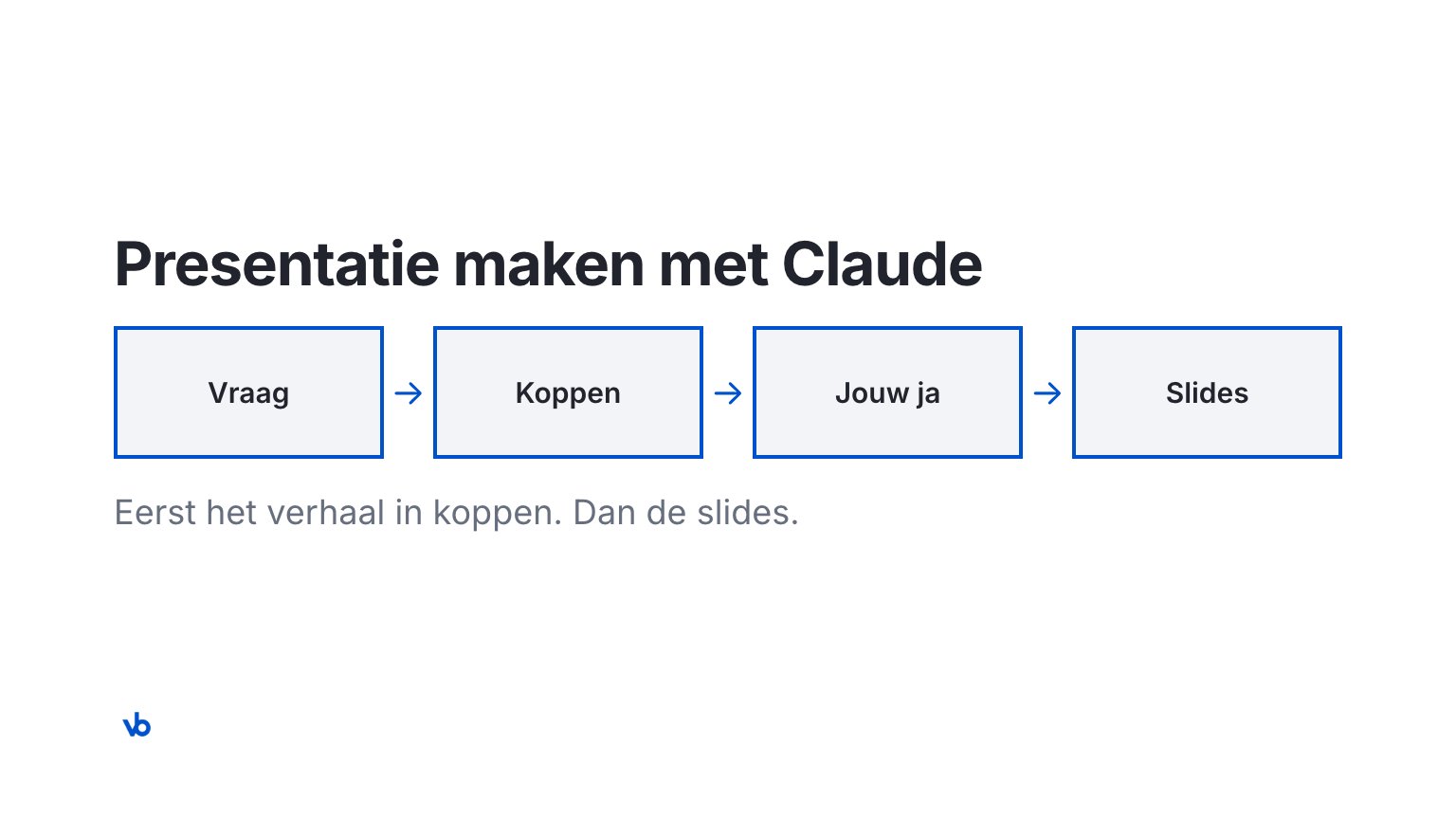
Making a presentation with Claude works best in two steps. First let Claude show the story in headings and approve it. Only then let Claude make the slides. If the knowledge comes from your company brain, the deck matches your offer, your audience and your brand style. You decide what goes out.
Quick Take: Do not ask Claude for slides right away. Ask for the story in headings first. With a company brain every deck comes from the same knowledge: one story, your own brand, and everyone tells the same thing.
I recorded one conversation in Claude, with a made-up company. I asked Claude to prepare an introductory call and then make a presentation. What I got back was not a deck. It was a list of five headings first, with the question whether the story was right. The slides only came after my yes.
In this post I show why that order works. And what it takes to make it work for you.
Why does a loose question to Claude give you a generic deck?
Claude makes neat slides. That is not the problem. The problem is what is on them.
Your team already uses AI. That AI just does not know how your company works.
If you ask for a presentation without that knowledge, Claude fills the gaps itself. The result looks good and could have come from any company. This is missing:
- what exactly you offer, and what you do not
- who the story is for
- how you say it, in your own words
- what a deck looks like at your company
- which proof you are allowed to show
This is not only true for decks. In why AI content does not sound like you I explain how to capture your brand voice.
What goes wrong if you ask for slides right away?
You get everything at once: the story, the structure and the design. So you judge everything at once. In practice you look at how it looks, and you miss that the story is off.
A mistake in the story then sits in every slide. Fixing it means rebuilding.
| Slides right away | The story in headings first | |
|---|---|---|
| What you judge | Story and design at once | Only the story first |
| When you adjust | When the deck is done | Before a single slide exists |
| If the story is off | You rebuild the deck | You change one line |
| Who decides | You, afterwards | You, before and afterwards |
There is one more effect. If every salesperson builds their own deck, every salesperson has their own version of the story.
The headings solve that. Five lines are quick to read. You see at once whether the structure is right, whether the offer is right and whether the next step fits this call. If something is off, you say so in one sentence.
How does story first, slides second work?
This is how it went in my recording:
- I asked one question: prepare my introductory call and then make a presentation.
- Claude first asked what was missing: which company, the goal of the call and the role of the person I would speak to.
- Claude took the knowledge from my brain: the customer profile, the offer, the proof that still applies and the rules for a deck.
- I got the story in five headings: opener, pain, demo, plan and next step.
- I read the headings and said yes. I could also have changed them.
- Then came the slides, in my own brand style.
- I read the deck. I decide what goes out.
This is not a loose prompt. It is a skill: a fixed instruction that turns the knowledge from the brain into work. The skill knows what to ask, where the knowledge is and at which moment you have to decide. You can read more in what Claude skills are.
The step before this, preparing the call itself, is described in prepare for a sales call with AI.
What does a company brain add to your presentation?
The order helps. The real gain is in the knowledge underneath. With a brain every deck comes from the same source. You notice that in four places:
| What you get | What it means |
|---|---|
| One story | Sales, marketing and CS tell the same thing. A colleague's deck does not differ from yours |
| Your own brand | Colours, typeface, logo and tone come from your recorded brand style, not from a template of the tool |
| Tailored to this call | The brain knows your customer profile. The deck is about the concern of this person, within your fixed story |
| All knowledge at hand | Your offer, the proof that still applies and your agreements are ready. You do not have to look anything up or explain it again |
It also helps whoever is new. A new colleague does not have to pull the story from old decks first.
And it stays right. If your offer changes, you change it in one place. The next deck uses the new version, for everyone.
It also works without a brain. Then the deck depends on who asks the question, and on what that person happens to know.
Which knowledge does Claude need for a deck in your brand style?
A deck in your brand style is more than your colours. This is what Claude needs to know:
| Knowledge | What it does in the deck |
|---|---|
| Offer | What you show, and what you leave out |
| Customer profile | Who the story is for, and which concern comes back in it |
| Proof that applies | What you may show, and what has expired |
| Rules for a deck | The structure, the number of slides and the length of a heading |
| Brand style | Colours, typeface and logo |
If that knowledge is spread over folders, old decks and people's heads, Claude cannot use it. If it is in one place, every skill uses the same knowledge. The sales deck then tells the same as the website and the proposal.
Which part of Claude makes the slides depends on how you work. In what Claude Design is the options are side by side.
What do you see in the recording?
The video above is a real screen recording of that conversation, shortened. You see my question, the five headings with my yes, and three slides from the deck.
The company in the recording is made up. It is an example with fictional data, not a result at a customer.
What is real: the deck uses my own offer and my own brand style. My own company runs on its own brain.
I do not mention times. What it gives you depends on your own tasks. We measure that together beforehand, with your numbers.
What does it not do?
- It does not decide. The story and the deck are ready. You approve, adjust and send.
- It does not invent proof. If proof is missing, there is a marker instead of a made-up example.
- It does not repair knowledge that is not there. If your offer is not recorded anywhere, you get a generic deck again.
- It does not store customer data. Data about a customer stays in your CRM. The brain only holds what your company knows and offers.
- It does not send anything. No deck goes to a customer unless you send it.
How do you start?
A deck that is right starts with knowledge that is right. A company brain records your offer, your audience and your tone in one place, so every skill works with the same knowledge. Read how the guided company brain works.
Sound familiar? Let's talk.
In 30 minutes we look together at which team your brain starts with. No obligation.
Frequently asked questions
Yes, if your brand style is recorded: your colours, your typeface, your logo and the rules for a deck. Without that knowledge Claude picks a style itself.
No. You can always ask Claude for slides. Without a brain you explain again with every question what you offer and for whom, and that then differs per colleague.
Because you then judge the story separately. You fix a mistake in the story in one line, instead of in every slide.
Yes. You read it, change what you want and decide yourself whether it goes out.
The knowledge of your brain also works in ChatGPT, I tested that. Skills in ChatGPT and other AI tools I test per customer.
No. The company in the recording is made up. It is an example with fictional data.